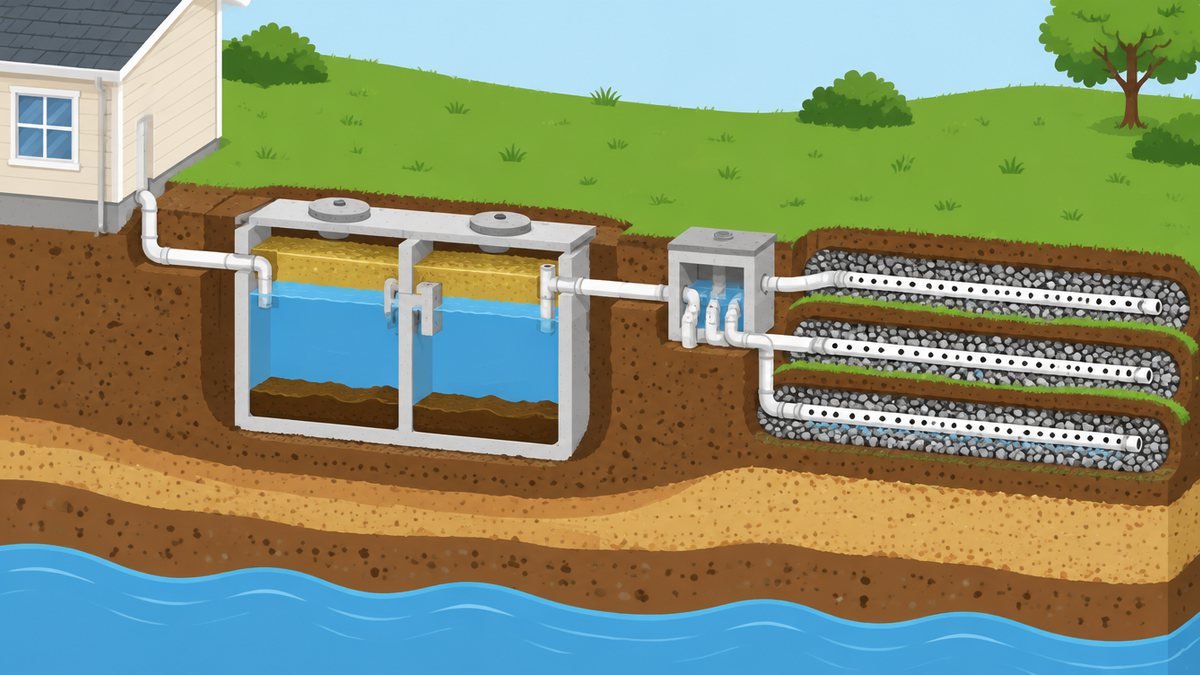
How does a septic system work? In short, it is a small, buried wastewater treatment plant for a home that is not connected to a city sewer. Everything that goes down your drains flows into a tank, where solids settle out, and then the liquid spreads into the soil of a drainfield, where the ground finishes the cleanup. This guide explains each part in plain English, what can go wrong and what you can safely do as an owner.
The two main parts: a tank and a drainfield
The U.S. Environmental Protection Agency (EPA) describes a conventional septic system as a septic tank and a drainfield, which it also calls a soil absorption field. Both are buried, which is why many owners forget about them until a drain backs up. Knowing what each part does makes it much easier to protect them.
Where your wastewater goes, step by step
- All the wastewater from your home leaves through one main drain and flows into the septic tank.
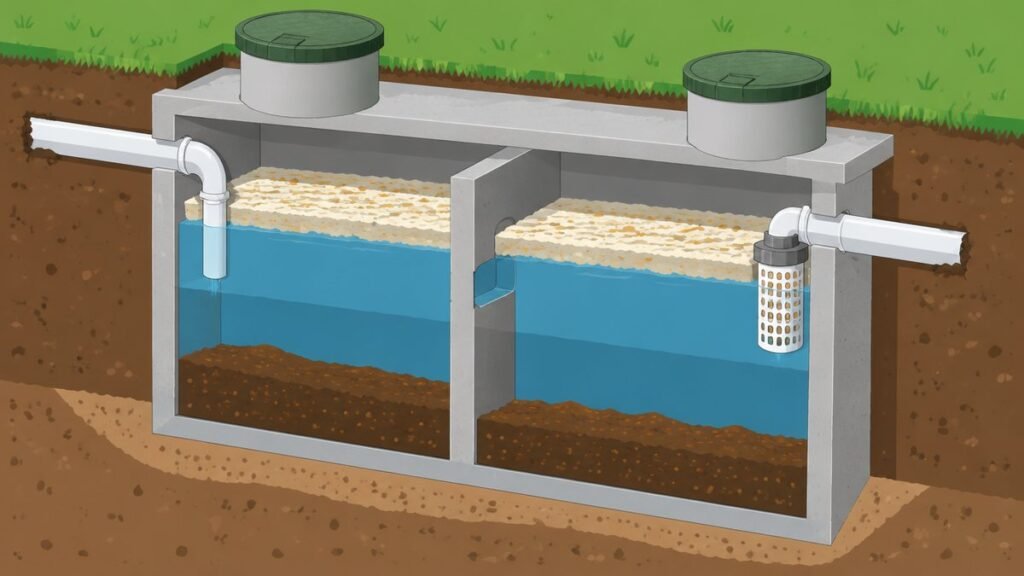
- In the tank, the wastewater separates into three layers. Oil and grease float as scum, the liquid called effluent sits in the middle, and solids settle to the bottom as sludge.
- Compartments and a T-shaped outlet help keep the sludge and scum from leaving the tank and reaching the drainfield.
- The effluent flows out of the tank and into the drainfield.
- In the drainfield, the effluent is piped onto porous surfaces in a shallow, covered excavation and seeps into the unsaturated soil.
- As the water moves down through the soil, the soil treats and disperses it. EPA says this process naturally removes harmful coliform bacteria, viruses and nutrients, and the water eventually reaches groundwater.
Inside the septic tank
The tank is a buried, watertight container, usually made of concrete, fiberglass or polyethylene. It does not finish the job. Its role is to hold the wastewater long enough for the heavy solids to sink and the grease to rise, so that mostly liquid moves on.
Those layers do not stay the same size. Over the years the sludge at the bottom and the scum at the top slowly build up, which is why the tank must be pumped out from time to time. If the solids are allowed to build up too far, they can move into the drainfield and clog it. Our septic system maintenance checklist explains how often to inspect and pump.
Inside the drainfield
The drainfield is where the liquid gets its final treatment. In a conventional system it is a trench or bed filled with gravel or stone, with fabric over the top to keep sand and dirt out, and perforated pipes that spread the effluent. The soil around and below the trench does most of the cleaning.
A drainfield can only take so much liquid at a time. EPA warns that if it receives too much, it can flood. Then sewage can reach the surface of the yard or back up into toilets and sinks. That is why water habits in the house matter as much as what happens underground.
The parts at a glance
| Part | What it does | What can go wrong |
|---|---|---|
| Septic tank | Holds wastewater so solids settle and grease floats | Solids build up and, if the tank is not pumped, can move into the drainfield and clog it |
| Outlet and compartments | Keep sludge and scum from leaving the tank | If they fail, solids reach the drainfield |
| Effluent filter (if installed) | Catches solids before liquid leaves the tank | Can need frequent maintenance, so it is part of every inspection |
| Drainfield | Lets the liquid seep into soil that treats it | Too much liquid can flood it, and sewage can surface or back up |
| Vent pipes | Let air move through the system | Clogged or frozen vents can cause odors |
| Pumps and controls (some systems) | Move effluent to where the soil can take it | Many need replacing every 10 to 20 years |
Not every septic system looks the same
The conventional design above is the most familiar, but it is not the only one. Some systems use a pump to move effluent to where the soil can take it, for example a pump chamber that sends it to a sand mound in measured doses. EPA notes that systems with electrical float switches, pumps or other mechanical parts should generally be inspected once a year, and that a service contract is recommended for them. If your system has a control panel, an alarm or a pump chamber, ask your septic professional what it does and how to read it.
What keeps a septic system healthy
Most septic failures come from the same few habits, and all of them are easy to change.
- Watch your water use. EPA says indoor water use can reach 70 gallons per person per day, and a single leaking or running toilet can add as much as 200 gallons per day. Fix leaks, run full loads and spread laundry over the week instead of doing it all in one day.
- Flush only human waste and toilet paper. Wipes (even the ones sold as flushable), diapers, paper towels, feminine hygiene products, dental floss, cat litter, coffee grounds and medications do not belong in the toilet.
- Keep grease and strong chemicals out of the drains. Do not pour cooking oil, paint, solvents or large amounts of toxic cleaners down the drain.
- Go easy on the garbage disposal. EPA says that if you use one, the tank will need to be pumped more often.
- Protect the drainfield. Do not drive or park on it, keep roof drains and sump pumps pointed away from it and avoid planting trees or shrubs over it.
How long does a septic system last?
There is no single answer, because soil, use and care all make a difference. EPA says a concrete tank may last 50 years or more, although older tanks may be less well built. Pumps and controls often need replacing every 10 to 20 years. A drainfield that is more than 25 to 30 years old is a candidate for an upgrade, and EPA advises planning for it before an emergency forces the decision.
Septic myths worth dropping
- “Additives keep the tank healthy.” EPA does not recommend septic tank additives and says they are not necessary for ordinary household wastewater. Some can even harm the system.
- “A smell always means failure.” Not always. The odor can come from a clogged or frozen roof vent, or from wind and site conditions. A wet, soft or spongy patch over the drainfield, especially when it has not rained, is a stronger sign.
- “If it drains, it is fine.” A system can look normal from the inside while the tank fills with solids. Regular inspections are how you find out.
If you spot real warning signs, our guide to common septic tank problems and fixes shows what to check and when to call a professional. And if your home has a private well as well as a septic system, see how a private well works.
When to call a professional
Property owners are responsible for routine maintenance. A typical professional inspection includes reviewing the records, opening and checking all the tanks, checking the effluent filter and the distribution box, and evaluating the drainfield. If something seems wrong, EPA recommends contacting a local septic service provider or plumber, since the cause of a problem, such as an odor, cannot be diagnosed from a distance.
Frequently asked questions
How does a septic tank work in simple terms?
Wastewater from the house flows into a buried, watertight tank. Heavy solids settle to the bottom as sludge, grease and oil float to the top as scum, and the liquid in the middle flows out to the drainfield.
Where does the water go after the septic tank?
It flows to the drainfield, where it seeps into the soil. The soil treats and disperses it, and the water eventually reaches groundwater.
How often should a septic tank be pumped?
EPA says a septic tank should be inspected every 1 to 3 years and pumped every 3 to 5 years. The right timing depends on tank size, household size, water use and how many solids build up.
Can I use a garbage disposal with a septic system?
EPA advises limiting its use. Food waste adds to the scum and sludge, so a household that uses a disposal will need the tank pumped more often.
Sources
These pages from the U.S. Environmental Protection Agency are good places to confirm the details, and your local health department can tell you what applies where you live.